Dong-hyun
𝐋𝐚𝐜𝐮𝐧𝐚 | 𝑱𝒆𝒐𝒏 𝑱𝒖𝒏𝒈𝒌𝒐𝒐𝒌Dong-hyun is Jungkook’s father and the defining source of the violence that structures the Jeon family’s history. His abuse is physical, verbal, and psychological: he attacks his son, controls Min-ha through fear, condemns crying as weakness, and treats obedience as proof of masculine worth. The consequences extend far beyond each assault. Jungkook grows up carrying Dong-hyun’s commands inside his own emotional life, while Min-ha and the family’s fractured relationships reveal how domestic violence can persist as an atmosphere even after the abuser is no longer present.## Identity and Family Background Dong-hyun is presented as a volatile patriarch whose authority depends on intimidation rather than care. Min-ha trembles when he enters the home, and the family’s emotional balance changes according to his mood. Jungkook’s childhood was not always defined by this danger: Min-ha recalls that Dong-hyun changed suddenly when Jungkook was four years old. Before that change, Jungkook was a calm child who demanded considerable attention, and Min-ha spent much of her time with him; Ye-jun was also devoted to his younger brother. The contrast gives Dong-hyun’s later cruelty a particularly destructive force, because it transforms the family home from a place of ordinary attachment into a site of anticipation and fear.
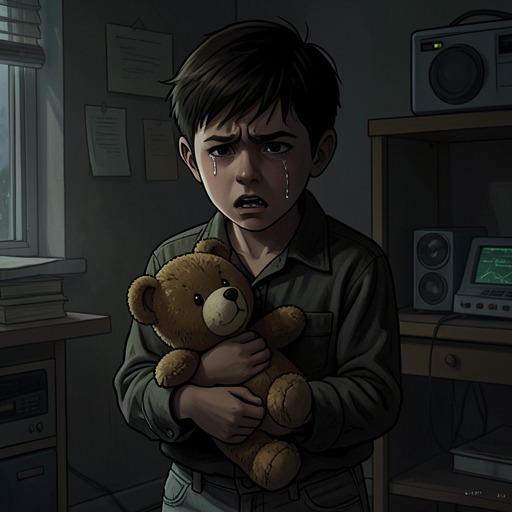
His relationship with Min-ha is organized around coercive control. When Jungkook’s distress draws attention to him, Dong-hyun responds not with concern but with contempt, asking why the child is crying. He then seizes Jungkook by the collar and declares that a man must never cry. This rule becomes one of the father’s most enduring forms of violence: it does not merely silence a particular emotion, but defines vulnerability as disobedience and demands that Jungkook perform hardness while he is afraid.
The same encounter establishes Min-ha’s constrained position. Dong-hyun’s anger turns toward the child, while Min-ha is already frightened and later tries to stop him from beating Jungkook. Dong-hyun rejects her intervention as an intolerable challenge to his authority. His violence therefore operates relationally, making one family member’s attempt to protect another dangerous for everyone involved.## Childhood Abuse and the Formation of Fear The clearest childhood assault occurs after dinner, when Dong-hyun goes upstairs and Min-ha follows, attempting to prevent him from striking Jungkook. Dong-hyun violently pushes his wife aside, enters Jungkook’s room, and confronts the boy directly. He laughs when Jungkook stands before him, reading the child’s courage not as resilience but as a provocation. Without warning, he slaps Jungkook, removes his belt, turns him onto his stomach, tears his shirt, and strikes his bare back with the leather.
Jungkook refuses to scream, but the silence is not evidence of safety or acceptance. He is unable to move, tears gather in his eyes, and grief gives way to a dark anger he cannot act upon. Dong-hyun’s violence thus creates the contradiction that will govern Jungkook’s adulthood: the son must suppress visible fear while absorbing an ever-growing impulse toward retaliation. The father’s demand that Jungkook remain still when he disciplines him is also a demand that the entire family remain silent. Dong-hyun explicitly orders Min-ha never again to move while he is correcting the boy, reducing protection itself to an act of defiance.
The abuse leaves a psychological inheritance rather than a closed childhood episode. Sunmi later recognizes in Jungkook the frightening darkness of someone whose inner life has been shaped by experiences that cannot easily be approached. Jungkook’s anger, violent impulses, insomnia, nightmares, substance use, and attraction to dangerous forms of release are not presented as identical to Dong-hyun’s cruelty, but they exist in the space created by it. The son struggles against becoming the kind of man his father represents while repeatedly approaching violence as the language most familiar to him.
The father’s influence also appears through Jungkook’s fear for Min-ha. When Jungkook later sees a wedding ring on his mother’s left hand, he immediately worries that her new partner may be another cruel man who subjects her to the same treatment she endured before. He suspects that her smile could be a façade and that her claim to be resting could conceal another attempt to protect herself. His fear shows that Dong-hyun has damaged Jungkook’s ability to read safety as ordinary; even a peaceful reunion is initially filtered through the possibility of renewed abuse.
Return and Confrontation
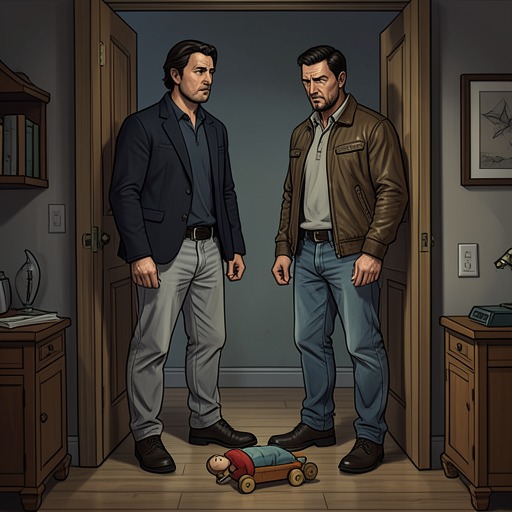
Dong-hyun reappears in Jungkook’s adult life not as a changed parent seeking reconciliation, but as a familiar threat. Jungkook recognizes him immediately and feels anger take control of the moment. Dong-hyun claims that he has returned for work and boasts that Ye-jun is managing the family business in his absence, adding that his other son at least knows how to make something of his life. The remark repeats the old structure of comparison and humiliation: Dong-hyun presents himself as the judge of masculine and social worth, while reducing Jungkook to the role of a failed, disobedient child.
Jungkook’s first concern is Min-ha. He asks whether she remains under Dong-hyun’s control, making explicit that the father’s power has never been understood as merely private marital conflict. Dong-hyun answers with contempt, saying that Min-ha left several months after Jungkook’s supposedly spoiled adolescent crisis and cruelly speculating about her dependence on other men. His account is designed to degrade her and to preserve his own version of events, but Min-ha later supplies a different history: she left because she could no longer safely address Dong-hyun, and she deliberately avoided contacting him while trying to find Jungkook.
Their meeting exposes the father and son as two people carrying opposing meanings of anger. Min-ha understands both as hot-tempered, yet she distinguishes the source and direction of their violence: Dong-hyun is vicious, whereas Jungkook is driven by a desire for justice. This distinction does not erase the danger of Jungkook’s rage, but it prevents the narrative from treating inherited anger as proof that father and son are morally identical. Jungkook’s struggle is precisely to act against the pattern without denying how deeply it has entered him.
Violence, Alcohol, and Legal Threats
The confrontation becomes physical when Dong-hyun finds Jungkook weakened by alcohol. He takes satisfaction in regaining control over his son, seizes him by the collar, and strikes him repeatedly in the face. Jungkook attempts to stop him, but ethanol has impaired his nervous system and leaves him unable to defend himself effectively. Dong-hyun continues until blood flows, turning the assault into a deliberate reenactment of the dominance he exercised in Jungkook’s childhood.
The scene reverses the apparent adult distance between them. Jungkook may be older, stronger, and capable of confronting the past, but Dong-hyun knows how to exploit the exact conditions that once made resistance impossible. Alcohol becomes an instrument of vulnerability, while the father’s physical confidence reveals that his authority still depends on the body of the person he is attacking. The recurrence is significant because it shows that the family’s violence is not remembered only through flashback; it returns as an active present-tense force.
Dong-hyun then declares that he will file a complaint. The threat converts personal violence into institutional pressure. After assaulting Jungkook, he attempts to position himself as the aggrieved party, extending the same reversal that elsewhere turns victims into suspects. His complaint is therefore part of his control: the father seeks not only to injure his son but also to define the official meaning of the encounter. The possibility of police involvement raises the stakes from private survival to a contest over whose account will be believed.
Control, Absence, and Min-ha’s Recovery
Dong-hyun’s disappearance from Min-ha’s daily life does not immediately end his psychological reach. Jungkook worries that her new marriage may conceal a repetition of the old pattern, and the sight of her wedding ring becomes a trigger rather than simple evidence of happiness. His fear asks whether apparent calm can be trusted, whether a smile can be a façade, and whether a claim of rest can conceal another protective lie. The questions reveal how coercive control survives separation through anticipation, suspicion, and the inability to recognize ordinary safety.
Min-ha’s explanation begins to interrupt that inherited fear. She tells Jungkook that Frank is exceptional and unlike Dong-hyun: he does not hit her and has helped her discover the world she should have been able to experience with her former husband. She and Frank even tried to locate Jungkook, but encountered Ye-jun, who did not know where he was. Min-ha’s refusal to contact Dong-hyun was not indifference toward her son; it was a boundary formed under threat. Her account restores agency to a woman whose choices Dong-hyun had previously described as moral failure.
The reunion also gives Jungkook access to a history before the abuse became total. Min-ha recalls that he was calm as a baby and sought a great deal of attention, while she devoted most of her time to him and Ye-jun loved being present with his younger brother. Dong-hyun had not always been the unpredictable man who terrorized the household; he changed abruptly when Jungkook was four. This detail does not excuse him or explain away the harm, but it clarifies the family’s grief: the violence destroyed an earlier form of domestic attachment and left its survivors measuring the distance between who Dong-hyun had been and what he became.
Narrative Function and Moral Contrast
Dong-hyun functions as the novel’s most intimate embodiment of the cycle of family violence. He teaches through assault, humiliation, and prohibition that strength means emotional silence, that authority means control, and that protection is rebellion. Jungkook later carries these lessons into conflicts involving Shelby, underground boxing, cocaine, alcohol, and revenge, but the narrative repeatedly marks the difference between repetition and resistance. Jungkook can become violent, yet he is also capable of remorse, care, and the decision to protect rather than dominate; Dong-hyun treats domination itself as his right.
That contrast is sharpened by the damage done to emotional expression. Dong-hyun’s command that a man must never cry turns a child’s fear into a source of shame, while Jungkook’s later need for comfort shows what the command has cost him. His history with Shelby includes moments when touch must be approached carefully because trauma has made contact dangerous, and moments when a gentle hand or patient presence offers security. Against Dong-hyun’s forced physical control, these later forms of contact depend on responsiveness and consent. They do not erase the father’s imprint, but they provide an alternative vocabulary for intimacy.
Dong-hyun’s influence also reaches the novel’s wider treatment of credibility and blame. Shelby describes how Madison refused to believe her account of sexual violence and how she was transformed at school from victim into culprit. Later, Shelby rejects Robert Jefferson’s attempt to portray her as someone pursuing money, arguing that malicious false accusations are used to make genuine victims feel guilty and remain silent. Dong-hyun’s domestic reversal of victim and aggressor belongs to the same moral world: power protects itself by controlling the story after it has caused harm. His violence is therefore personal, but its logic extends into the institutions and social judgments that decide whom to believe.
Dong-hyun is not redeemed, reconciled with Jungkook, or granted the final authority over the family’s meaning. His importance lies in the pattern he establishes and in the resistance required to break it. Jungkook’s later remorse after returning to the Ares Garden, his recognition that vice had overwhelmed his judgment, and his efforts to repair the damage he causes all acquire their full significance against the father’s example. Where Dong-hyun answers fear with greater fear and injury with renewed domination, Jungkook gradually searches for accountability, protection, and a form of justice that does not simply reproduce the violence it opposes.